
Cashback Programs Compared: Real Value vs Marketing Numbers

RN Plain-English decode
A 15% cashback offer does not mean a player automatically gets that same share of every dollar lost back in cash. It usually means the headline percentage of net losses…
A 15% cashback offer does not mean a player automatically gets that same share of every dollar lost back in cash. It usually means the headline percentage of net losses converted to bonus credit, then locked behind a wagering requirement before any of it can be withdrawn. Run the full mechanism through the arithmetic and the real return often lands at a third or less of the advertised figure.
Cashback is not the same thing as a deposit-match bonus or a reload offer, though marketing pages blur the three together. A deposit-match adds credit based on how much money comes in. A reload bonus applies to a later deposit following the same structure. Cashback works differently. It returns a slice of what a player already lost over a defined period, typically a week or a month. That distinction matters because each type carries its own wagering terms, and cashback’s terms are usually the least favorable of the three. The specific percentages and dollar figures used throughout this article are worked, illustrative examples chosen to show how the mechanics operate; individual programs set their own figures.
What a Cashback Headline Actually Means in Dollars
The headline percentage applies to net losses only. Net loss means money wagered minus any money returned from wins. A player who deposits $300 and wagers it through a session might end the week down $200. That net loss produces a payout of $30 under that offer. That’s the advertised math, and it’s accurate as far as it goes.
The catch sits in what happens to that payout amount next. It almost never lands as withdrawable cash. It arrives as bonus credit, which means it carries its own wagering requirement before a player can touch it.
The Wagering Requirement Is Where the Number Shrinks
A 10x wagering requirement on that payout means the player has to wager a significant sum in total bets before the credit, and any winnings generated from it, become withdrawable. Compare that to a 1x requirement, which asks for minimal additional wagering before release. The multiplier is doing most of the work in determining what the cashback is actually worth to the player.
Here’s the mechanism in table form:
| Cashback payout | Wagering multiplier | Total wagering required | Realistic time to clear |
|---|---|---|---|
| $30 | 1x | $30 | A session or two |
| $30 | 10x | $300 | Several sessions, variance-dependent |
| $30 | 20x | $600 | A week or more of regular play |
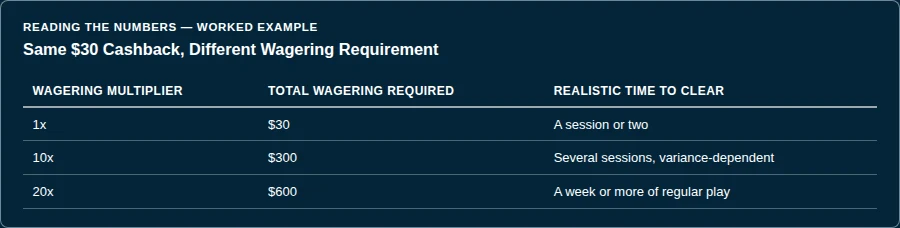

A 20x requirement on a modest cashback payout turns that "free" credit into an extended play demand. In most programs, clearing the requirement means continuing to wager real money until the target is met. Most players lose some portion of that $300 or $600 in the process, which is the structural effect of pairing a modest cashback payout with a high multiplier. The bonus isn’t cash. It’s a reason to keep the balance active.
Game Weighting Cuts the Number Again
Not every bet counts equally toward clearing a wagering requirement. Slots commonly count 100% of the wager toward the total. Table games like blackjack or roulette often count only a fraction, and some games count nothing at all. This is called game weighting, and it’s listed in the bonus terms, not the promo banner.
A player who prefers blackjack faces a substantial disadvantage. Table games often carry a much lower weighting, often only around one-seventh of each wagered dollar, meaning they contribute far less toward the requirement. A $300 wagering target for slots might demand $2,000 in blackjack wagers instead. The headline cashback figure never mentions this weighting difference. The terms page does, typically in a collapsed section near the bottom.
This single mechanism explains why cashback programs feel generous to slots players and nearly worthless to table-game players, even when both are nominally offered the same percentage.
Caps, Expiry Windows, and the Pieces Nobody Reads
Two more mechanisms shrink the number further.
A maximum cashback cap per period limits how much can be paid out regardless of the stated percentage. A player who loses $1,000 in a week might expect substantial cash back, but a $75 weekly cap means that figure is the ceiling regardless of actual losses. The cap is usually listed, but rarely next to the headline percentage.
Expiry windows on unused bonus credit are the second piece. These windows commonly run from about a week up to a month, and they forfeit the cashback entirely if the wagering requirement isn’t cleared in time. A wagering requirement paired with a 7-day expiry creates urgency. A player needs roughly $43 per day in turnover just to keep the credit alive, win or lose.
Win caps add a third layer. Some programs limit how much can be withdrawn from wins generated using bonus-funded bets, even after wagering is cleared. A bonus credit that generates a substantial win can still be capped at withdrawal, with only a portion of that win becoming available cash.
Combine several common restrictions, such as a 10x wagering requirement, table-game weighting, a weekly cap, and a brief expiry window, and the realized value shrinks dramatically. Most players end up recovering only a fraction of the headline percentage in actual benefit. That gap between advertised and realized value is not a flaw. It’s the business model.
A Worked Example, Start to Finish
Consider a player who deposits $400 and loses $250 over a week, mixing slots and table games.
| Starting Deposit | Net Loss (Week 1) | Headline Rate | Base Cashback | Wagering Requirement | Game Mix | Extra Loss (Clearing) | Final Outcome |
|---|---|---|---|---|---|---|---|
| $400 | $250 | 15% | $37.50 | $375 (10x) | 70% slots, 30% blackjack | $40 | Worse off than without offer |
Under the headline offer, the base cashback appears modest. The wagering requirement sets a substantial target. Game weighting matters significantly. Slots contribute fully toward clearing, while blackjack contributes only a fraction. This mix means clearing the requirement demands additional play and real-money risk.
Assume, for this example, that normal game variance costs the player another $40 while clearing that wagering requirement. Net the two together. A $37.50 cashback payout minus $40 in variance-driven losses incurred solely to clear it leaves the player $2.50 worse off than if the offer had never existed, since that extra wagering session would not have happened otherwise. This outcome is realistic for many players and represents the scenario cashback marketing never models.
Cashback vs. Deposit-Match: Why the Comparison Matters
A deposit-match bonus of 100% up to $200 means a deposit at that cap is matched in full, adding the same amount in credit immediately, before any losses occur. Cashback only pays out after losses have already happened and applies solely to the losses rather than the deposit. The two sound similar in marketing copy. They’re structurally opposite.
This is worth understanding before comparing the headline numbers on two different promotions. A 50% deposit match and a cashback offer like the one above are not competing on the same basis. Which one serves a player better depends on several things at once. Whether they expect to win or lose that session matters, and so do the wagering multiplier and game weighting attached to each offer, any payout cap, the expiry window, and the withdrawal terms on bonus-funded wins. For a broader look at how advertised return figures relate to real outcomes, the RTP guide for slots covers the same gap between a quoted percentage and what actually happens over a real session.
How to Read a Cashback Offer Before Opting In
A few questions cut through the marketing language fast:
- What is the wagering multiplier on the cashback payout itself, not the deposit?
- Does game weighting apply, and what’s the weighting for the games actually played?
- Is there a maximum cashback cap per week or month?
- What’s the expiry window on the bonus credit once it’s issued?
- Is there a win cap on withdrawals from bonus-funded wins?
Five questions, and the answers are usually buried in the same terms page the headline percentage never links to. Marketing incentives shape how these numbers get framed long before a player ever sees the fine print — the same dynamic that shows up in how affiliate sites make money off casino referrals.
FAQ
Is cashback the same as a deposit-match bonus?
No. A deposit-match adds credit based on money deposited, calculated before any losses. Cashback returns a percentage of net losses after a defined period, usually a week or month.
What does a 10x wagering requirement on cashback mean?
It means total wagering (the sum of all bets placed) must reach 10 times the cashback amount before that credit and any winnings from it become withdrawable. A $30 cashback payout with that multiplier needs $300 in total wagering.
Why does game choice affect how fast a wagering requirement clears?
Game weighting assigns different contribution rates per game type. Slots often count 100% toward wagering. Table games like blackjack or roulette often contribute only a modest fraction of each wager toward clearing, and some games contribute nothing at all. A player favoring low-weighted games needs to wager far more to clear the same requirement.
Can cashback credit expire before it’s used?
Yes. Expiry windows, often lasting from about a week up to a month, forfeit unused bonus credit if the wagering requirement isn’t cleared in time. This is separate from any cap on how much cashback can be earned per period.
Does a cashback cap limit how much a player can actually receive?
Yes. A maximum cashback cap per period limits the payout regardless of the stated percentage. A player with large losses may hit the cap well before reaching the percentage-based figure the offer advertises.
This article is written for a Saskatchewan audience (19+); for problem-gambling support, resources are available through PlayNow Saskatchewan and the SLGA-affiliated helpline, 1-800-306-6789.