
Understanding RTP in Slots: How to Pick High-Return Games

RN Plain-English decode
RTP is the single number that tells you how much of every dollar wagered a slot returns over the long run, and picking games above roughly 96% — while pairing…
RTP is the single number that tells you how much of every dollar wagered a slot returns over the long run, and picking games above roughly 96% — while pairing that with a volatility level that matches your bankroll — is the one habit that meaningfully changes what a session of play actually costs. The figure is calculated over millions of spins, so it won’t predict any single session. It gives you a way to compare games before you spend a cent.
What Is RTP and How Does It Work
Return to Player, or RTP, is the theoretical percentage of all wagered money a slot pays back over an extended period. A 96% RTP means that, in theory, players get back that share of every dollar wagered over time. The house keeps the remainder as its edge. Independent testing agencies like eCOGRA verify these figures for many regulated operators, and reputable studios publish them openly.
The calculation runs across millions of simulated spins, which is why short-term results can drift so far from the published rate. A single bonus round or a long dry spell can make a session feel completely disconnected from the number on the game’s info screen. Over thousands of sessions, though, the math asserts itself.
Key RTP concepts worth holding onto:
- RTP is a long-run average, never a per-session promise
- Higher RTP reduces the theoretical cost of play over time
- The house edge is simply 100% minus the RTP figure
- Certified games carry verification from independent testers
RTP Categories and What They Mean
Slots generally fall into four RTP bands that help set expectations before you play.
| RTP Range | What It Means |
| Below 94% | High house edge; usually progressive jackpots or licensed-brand games |
| 94–96% | Standard range for many popular slots |
| 96–97% | Above-average return; a solid default target |
| Above 97% | High-return games; rarer and worth seeking out |
Progressive jackpot slots often show lower base-game RTP because a portion of every bet feeds the growing jackpot pool, with the advertised jackpot forming part of the overall return calculation. If you’re chasing a life-changing win, the tradeoff is built into the rate.

How to Find RTP Information
Finding a slot’s RTP takes less than a minute once you know where to look. The game’s info screen, usually accessible from the lobby or within the game itself, lists the rate for most modern slots. Casino sites also publish this data on individual game pages, often under a details or information tab.
Where to find RTP information:
- The game’s paytable or info screen inside the slot
- The casino’s game details page
- Developer websites that publish certified rates
- Independent slot databases like SlotCatalog that track figures across versions
Some operators offer configurable RTP versions of the same game, with one certified rate running at one casino and a different rate at another, depending on the operator’s chosen configuration. Always check the rate at the specific casino where you’re playing, because the same title can carry different figures in different places.
RTP Versus Volatility: Understanding the Difference
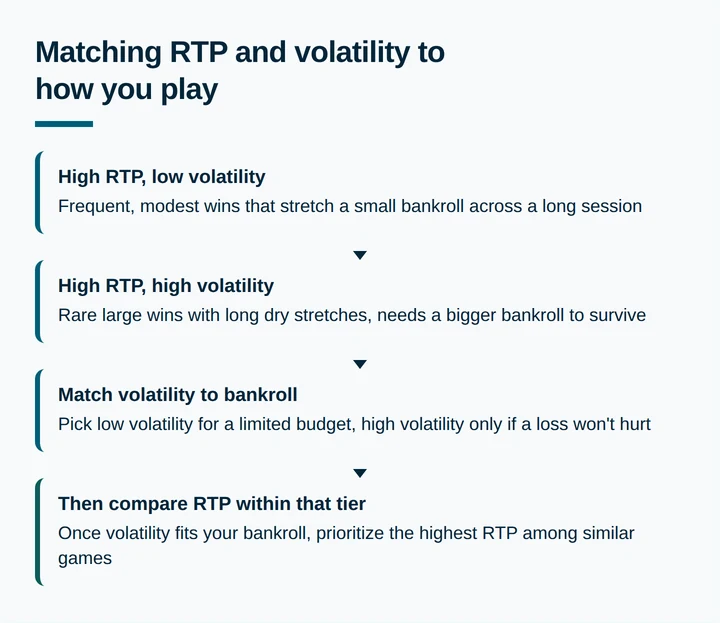
RTP and volatility answer two different questions. RTP tells you how much a game returns over the long run. Volatility tells you how those returns are distributed across sessions, from frequent small wins to rare larger ones.
Volatility categories follow a familiar pattern:
- Low volatility: frequent, smaller wins; longer playtime on a fixed bankroll
- Medium volatility: a balanced mix of win frequency and win size
- High volatility: infrequent wins with the potential for larger payouts
The two metrics work together in practice. A high-RTP, low-volatility game like Blood Suckers delivers steady value that stretches a bankroll across many sessions. A high-RTP, high-volatility game offers the same theoretical return with much wider swings between sessions, suiting a player comfortable with long dry stretches between meaningful wins. Matching both to your bankroll is the priority that pays off before chasing the highest RTP. A low-volatility game can serve a small bankroll better than a high-volatility game at the same RTP, simply because the former keeps you in action longer. The reverse holds for players chasing bigger payouts who can absorb the variance.
Best High-RTP Slots for Canadian Players
These four slots are available at Canadian-facing online casinos, each carrying a verified RTP rate published by its developer.
- Blood Suckers (NetEnt) — 98.00% RTP, low volatility, 5 reels and 25 paylines, vampire theme.
- 1429 Uncharted Seas (Thunderkick) — 98.6% official RTP (trackers show real-time variance between 98.41% and 98.6%), medium volatility, nautical exploration theme.
- Marching Legions (Relax Gaming) — 98.12% official RTP (trackers note real-time variance between 97.13% and 98.75%), Roman legion theme with a mechanic where symbols march across the reels; the rate can shift slightly depending on which features activate during play.
- Mega Joker (NetEnt) — the often-quoted 99% figure applies only to Supermeter mode at maximum bet (10 coins per spin); the base game runs around 85.1% RTP, and minimum-bet play drops further to roughly 76.9%.
Common RTP Misconceptions
Several myths about RTP persist even among experienced players. The most common is the gambler’s fallacy, the belief that a slot “owes” a win after a long losing streak. Each spin is an independent event, and past results have no influence on future outcomes. A game’s RTP doesn’t make it more likely to pay out after a dry session, no matter what the published rate is.
Another misconception treats RTP as a session-level guarantee. A 98% game can still produce a losing session, sometimes a painful one, because the published rate only manifests over hundreds of thousands of spins. Short-term results follow probability distributions that swing around the long-run average.
A third error involves comparing RTP across different game types without context. A progressive jackpot slot with a lower base RTP can still deliver equal or better total value than a fixed-jackpot game with a higher one, because the progressive’s total return includes the jackpot pool. The advertised rate already accounts for this, so comparing base rates alone misses part of the picture.
Practical Application of RTP Knowledge
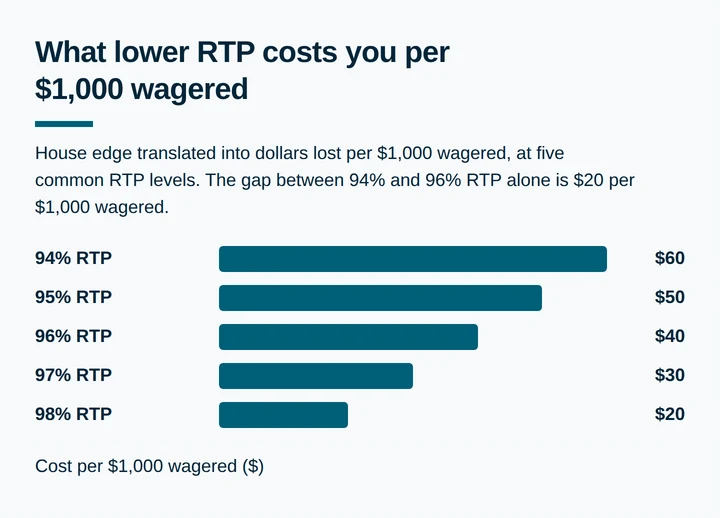
Applying RTP knowledge comes down to one habit. Prioritize RTP first among games with similar features, then match volatility to your bankroll. Two adventure-themed slots with comparable bonus mechanics might differ by 2% in RTP, and that difference compounds meaningfully over time.
A two-percentage-point gap in RTP works out to $20 per $1,000 wagered. Over a month of regular play, that gap covers the cost of several extra sessions. The math works the same way at every level, which is why small RTP differences deserve attention before you commit to a game.
Wagering requirements interact with RTP in ways worth understanding. A bonus with a fixed wagering requirement carries a different expected cost depending on the RTP of the slot you clear it on, since a higher RTP returns more of every dollar wagered toward clearing that requirement. Players who clear bonuses should factor both the RTP and the requirement into their calculation of whether a promotion actually offers value.
One practical habit serves most players well. Check the RTP before you play, note the volatility, and confirm both match your bankroll and session goals. This takes under a minute and costs nothing, yet it shapes the long-term cost of play more than any other single decision.
Frequently Asked Questions
What is a good RTP for online slots?
A good RTP falls in the top two bands from the table above, and anything below 94% carries a house edge large enough to erode a bankroll noticeably faster over time.
Does RTP guarantee how much I’ll win in a session?
No. RTP is calculated over millions of spins, so it only manifests over extended play. A single session can end far above or below the published rate, and each spin remains an independent event. The figure shapes long-term cost, not short-term outcomes.
Why do some slots have different RTP at different casinos?
Operators can choose from configurable RTP versions of the same game. A developer might publish several certified rates for one slot, and each casino selects which version to run. Always verify the rate at the specific casino where you play, since the game’s name alone doesn’t guarantee a single figure.
Are high-RTP slots always the best choice?
Not necessarily. A high-RTP slot with high volatility can drain a small bankroll before the math has a chance to assert itself. The best choice pairs a strong RTP with a volatility level that matches your bankroll size and how long you want to play.