
How to Start Playing at Online Casinos in Canada: Step-by-Step Guide

GS Plain-English decode
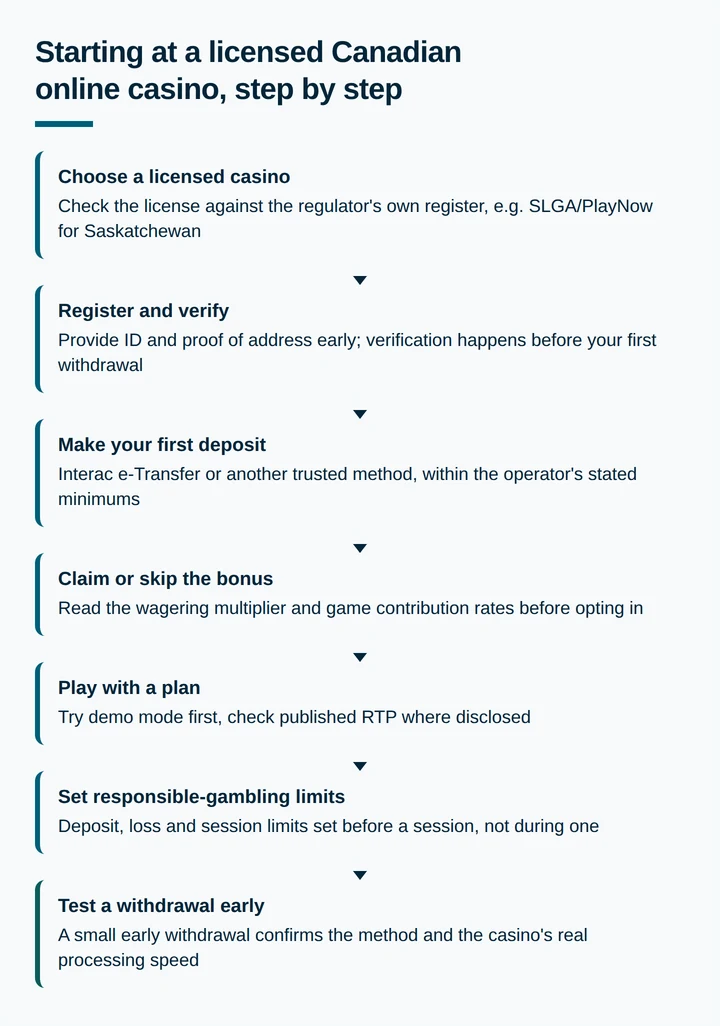
Starting at a licensed Canadian online casino comes down to five checkable things. You need a real license, accurate ID at signup, a deposit method you already trust, bonus terms…
Starting at a licensed Canadian online casino comes down to five checkable things. You need a real license, accurate ID at signup, a deposit method you already trust, bonus terms you read before you claim them, and a withdrawal process you test before you need it for real money. I’ve grounded each one in how regulation actually works here, using Saskatchewan’s own framework as the reference point.
Step 1: Choose a Licensed Casino
Your first task is confirming the casino actually holds the license it claims. In Saskatchewan, that means checking against the Saskatchewan Liquor and Gaming Authority (SLGA), which regulates online gambling under the Alcohol and Gaming Regulation Act, 1997. Policy and management sit with Lotteries and Gaming Saskatchewan (LGS), a Crown corporation.
PlayNow Saskatchewan, operated by the Saskatchewan Indian Gaming Authority under SLGA oversight, is currently the only platform licensed to offer real-money online casino play to Saskatchewan residents. Its license is verifiable directly against the SLGA register, which makes it a concrete model for what a properly licensed operator looks like.
You’ll also see casinos elsewhere on this site referencing Malta Gaming Authority or Curaçao licenses. Those are common for operators serving players outside a province’s own platform. They’re a different regime entirely. Holding one doesn’t confirm authorization to serve Saskatchewan residents.
Take the claimed license number and check it against the regulator’s own published register. SLGA/LGS for Saskatchewan, or the relevant regulator’s list elsewhere. It takes a few minutes, and it beats taking a “licensed” badge at face value.
Step 2: Complete Registration and Verification
Saskatchewan’s legal gambling age is 19, including online play through PlayNow Saskatchewan. Licensed platforms must verify age and identity before you play for real money. Other provinces set their own ages, so check locally if you’re outside Saskatchewan.
Registration itself is straightforward. You provide your name, date of birth, and address. The verification step is where new players stall. Casinos need to confirm who you are before that first withdrawal, and having documents ready speeds everything up.
| Document Type | Requirements |
| Government-issued photo ID | Valid passport, driver’s licence, or provincial ID; must match your registered name and date of birth |
| Proof of address | Recent utility bill or bank statement showing your name and current residential address |
| Proof of payment method | Photo or statement confirming you own the card or e-wallet account used for deposits |
Uploading these at registration avoids a common cause of delayed payouts, which is waiting until withdrawal day to submit them.
Step 3: Make Your First Deposit
Interac e-Transfer is the deposit method most Canadians already know. It’s a real-time bank-to-bank transfer operated by Interac Corp. You send money using an email or phone number, no card required. It’s widely available at Canadian-facing licensed casinos.
Deposit minimums vary by operator and payment method. They commonly fall in the $10-$20 range for e-Transfer and card deposits at Canadian-facing licensed casinos, but there’s no single industry-wide floor, so always check the casino’s own cashier page before committing.
One habit worth building early is setting a deposit limit before your first real-money deposit. Do it after a losing session and you’ll be setting limits in the wrong frame of mind. Many licensed platforms let you cap how much you can add per day or week, and cooling-off periods are available if you need a break.
Step 4: Claim Your Welcome Bonus
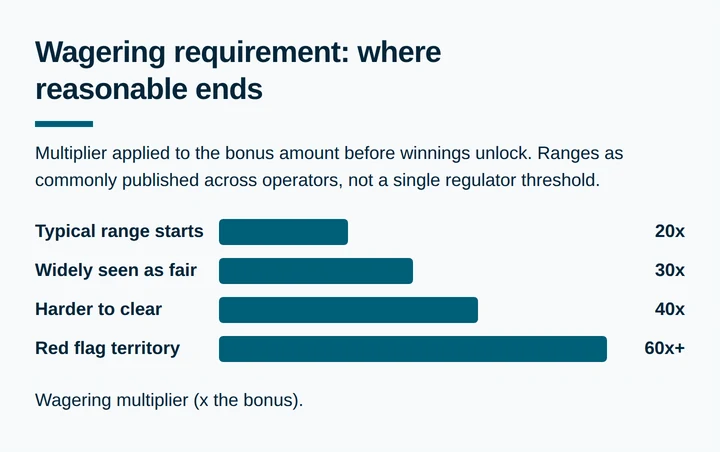
Welcome bonuses look generous until you read the wagering requirements. Deposit-match offers commonly carry playthrough requirements in the roughly 20x–40x range. A requirement around 30x or lower on the bonus amount is generally reasonable. At 40x and above, especially when certain games contribute less or not at all, clearing the bonus becomes genuinely hard.
Those contribution rates matter more than most new players realize. Slots typically count 100%, but table games and live dealer titles often count a fraction or nothing. A 40x requirement on a bonus you can only clear on slots changes what you can actually play. It also changes how much fun you’ll have, since you’ll be locked into one game category until the requirement is met. Check the wagering multiplier, the game restrictions, and the maximum bet allowed while the bonus is active. If the terms feel buried or vague, that’s a signal about the operator.
Step 5: Explore Games and Start Playing
Most licensed casinos let you try games in demo mode before spending real money. Demo mode costs nothing and shows you how a slot’s mechanics, bonus rounds, and volatility actually feel.
Game libraries typically sort into slots, table games, live dealer, and sometimes specialty titles like scratch cards or keno. Trying a few categories in demo mode helps you find what you enjoy. You don’t need to chase whatever’s promoted on the homepage. Popular titles like Starburst by NetEnt are common examples you’ll see across many licensed casinos, but you’re not limited to what’s featured.
Return-to-player (RTP) is the theoretical percentage a game pays back over time. Check the published RTP where the game or operator discloses it. There’s no universal regulator-set floor, so treat any marketing claim of a specific percentage as something to verify against the game’s own information. It’s not an industry norm.
Step 6: Practice Responsible Gambling
If you’re in Saskatchewan and gambling stops being fun, the Saskatchewan Problem Gambling Helpline is free, confidential, and available 24 hours a day at 1-800-306-6789. Save that number before you need it, so you won’t be hunting for it in a crisis.
PlayNow Saskatchewan offers self-exclusion and account-level tools. These include deposit limits, time limits, and reality checks, consistent with the GameSense framework used across Canadian provincial platforms. These tools work best when set proactively. Decide your loss limit before a session, not during one.
For broader mental-health support, the Centre for Addiction and Mental Health (CAMH) provides resources that apply nationally, though it’s based in Ontario. Start with your province’s own helpline. It’s the one wired into local services.
Step 7: Understanding Withdrawals
Withdrawals are where new players discover whether they picked a good casino. E-wallet withdrawals at licensed casinos typically process within roughly 24–48 hours once your KYC is complete, sometimes faster. Bank transfers take longer, commonly in the 3–7 business day range.
These are industry-typical figures. Actual timing varies by operator and depends heavily on when you completed identity verification. That’s why the KYC advice from Step 2 matters. A player who uploaded documents at registration withdraws in days, while one who waits until withdrawal day adds that verification time on top.
Test the withdrawal process early with a small amount. It confirms the method works and shows you the casino’s actual processing speed before real money is on the line. Don’t leave it until you’re waiting on a big payout to find out.
Conclusion
Starting at a licensed Canadian online casino doesn’t require special knowledge. You just need a willingness to check the license, verify your identity early, and read the terms before claiming anything. Saskatchewan’s framework gives you a clear model. SLGA-regulated platforms, a 19+ age requirement, and PlayNow’s tools for staying in control all point the way. Follow those seven steps and you’ll have covered the practical ground that separates a smooth experience from a frustrating one. Check the license first.
Frequently Asked Questions
How long does registration and verification take at a licensed Canadian online casino?
Registration takes a few minutes. Verification depends on how quickly you submit documents and how fast the casino reviews them. Uploading your ID, proof of address, and payment method at signup rather than before your first withdrawal is the fastest route.
What’s the minimum deposit at Canadian online casinos?
It varies by operator and payment method. Minimums commonly fall in the $10-$20 range for e-Transfer and card deposits at Canadian-facing licensed casinos, but there’s no single industry-wide figure. Always check the casino’s own cashier page for its own limits.
Can I try casino games for free before playing for real money?
Yes. Licensed casinos offer demo mode on most slots and many table games, letting you play with virtual credits. It’s a practical way to learn a game’s mechanics before committing real money.
What wagering requirements should I look for in a welcome bonus?
Requirements around 30x or lower on the bonus amount are generally reasonable. At 40x and above, especially with restricted game contributions, the bonus becomes significantly harder to clear. Read the full terms before claiming.