
Common Myths About Online Casinos — Debunked

WS Plain-English decode
Every one of these eight online-casino myths falls apart against two core facts. Licensed operators are independently audited, and the house edge already guarantees a profit without any need to…
Every one of these eight online-casino myths falls apart against two core facts. Licensed operators are independently audited, and the house edge already guarantees a profit without any need to cheat. Once you understand those two realities, most of what you hear about rigged games, lucky times, and guaranteed systems stops making sense. Separating myth from operational reality just takes checking a few verifiable facts.
Myth 1: Online Casinos Rig Games to Prevent Wins
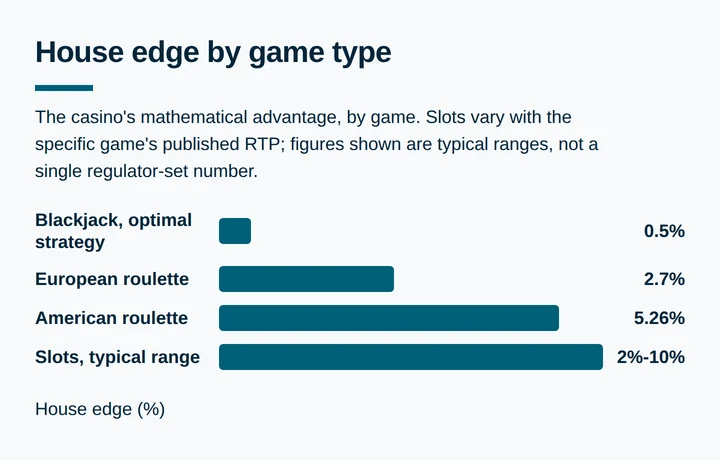
If a licensed casino rigged its games, it would be throwing away its business model. The house edge already ensures the casino profits over time. Slots typically run roughly 2% to 10%, European roulette carries about a 2.7% edge, and American roulette sits near 5.26% because of the extra double-zero pocket. Blackjack played with optimal basic strategy can get as low as roughly 0.5%. Why risk a license by cheating when the math already works?
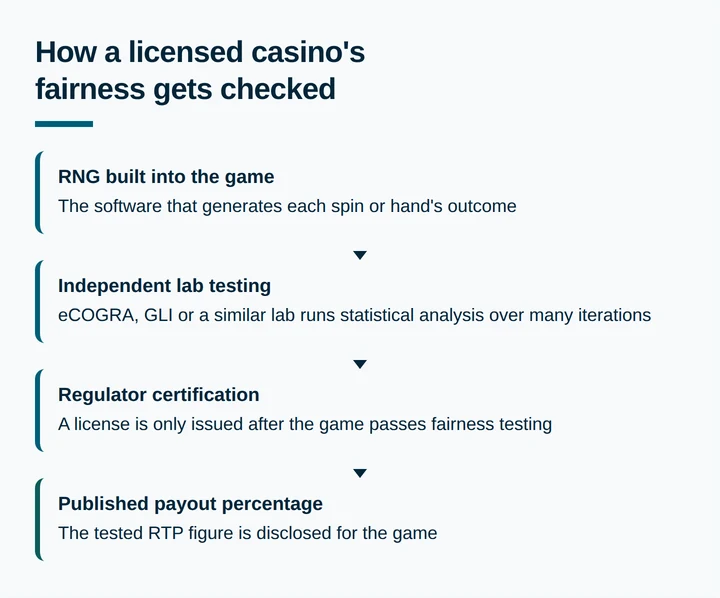
Independent testing labs exist specifically to stop rigging before it starts. Bodies like eCOGRA (established 2003 in the UK), Gaming Laboratories International (GLI), iTech Labs, and Technical Systems Testing (TST) audit licensed casinos’ Random Number Generators. They run statistical analysis over many iterations to confirm outcomes are unbiased and match expected probabilities before certifying a game as fair.
Casinos don’t rig games because:
- Rigging risks their license and reputation for no financial gain
- The house edge guarantees profit without any manipulation
- Independent audits make sustained rigging nearly impossible to hide
A casino that passed an RNG certification has documented proof its games run fairly. That certification is public, and you can check it.

Myth 2: You Can’t Win Real Money at Online Casinos
Real money wins happen constantly — the question is how fast you can access them. Licensed casinos process withdrawals through the same banking systems as any legitimate business, and the money lands in real accounts.
The processing time depends mostly on the method you choose. E-wallet withdrawals are typically approved within roughly 24 to 48 hours once your identity is verified, sometimes faster. Bank transfers take longer, commonly cited in the 3 to 7 business day range. Each operator sets its own processing timeline based on banking partners and KYC procedures.
| Withdrawal Method | Processing Time |
| E-wallet | 24–48 hours (typical) |
| Bank transfer | 3–7 business days (typical) |
The real bottleneck is usually identity verification, which happens on your end. Completing KYC right after you register means your first withdrawal doesn’t stall while documents get reviewed. That’s a practical step any player can take, and it makes the process smoother.
Myth 3: Casinos Track When You’re About to Win
This myth imagines a casino employee watching your screen, waiting for a hot streak to cut off. Each spin or hand uses an RNG that operates independently of every previous result. The system has no memory of your session, your bet size, or your recent losses.
A certified RNG produces outcomes that are statistically independent events. The casino doesn’t know you’re “about to win” because no such state exists. Your next result has the same probability whether you just won five hands in a row or lost twenty.
What players sometimes interpret as tracking is actually variance. Losing streaks feel personal, and a sudden win after a dry patch can feel like the casino “let you” win. The win is simply probability smoothing out over time.
Myth 4: Online Slots Pay Better at Certain Times
If slots paid better at 2 AM or on Tuesday afternoons, someone would have published the schedule by now. The RNG doesn’t consult a clock. Every spin carries the same odds regardless of the hour, the day, or how long you’ve been playing.
The confusion comes from payout percentages, which are published per game and calculated over hundreds of thousands of spins. A slot with a 96% RTP pays back $96 per $100 wagered on average. That average plays out across thousands of spins, never in a concentrated short window. Slots have no “generous phases” to time.
Session results feel different at different times because of variance. A short session can land anywhere on the spectrum, and that randomness creates the illusion of good and bad periods. The game’s odds remain constant; only the outcomes shift.
Myth 5: Betting Systems Guarantee Profits
The Martingale system works by doubling your bet after every loss, which creates an appealing logic. Eventually you’ll win and recover all prior losses plus gain one unit of profit. This appears sound in theory because the win covers the accumulated losses from the streak. In practice, a losing streak that outpaces your bankroll ends the strategy completely. The Fibonacci sequence applies the same flawed logic in a different wrapper. No betting progression changes the underlying house edge on any game.
These systems fail for a simple reason: table limits and bankroll caps exist. A system that requires unlimited funds to work isn’t a strategy, it’s a fantasy. Even if you win small amounts repeatedly, one extended losing run wipes out all prior gains.
What betting systems do well is structure your play. Setting a stake level and sticking to it keeps sessions disciplined. That’s useful for bankroll management. No betting progression can overcome the house edge built into each game.
Myth 6: New Players Get Better Odds
The idea that casinos lure new players with better odds to hook them ignores how the math works. A casino’s edge on any given game is fixed by the rules and the RNG. The house edge stays the same whether you registered yesterday or a year ago.
What new players actually get is bonuses. Welcome offers, free spins, and deposit matches are real incentives, but they don’t change the underlying odds of the games. A bonus gives you extra playing time with the same odds on each spin or hand.
Confirmation bias drives this myth. New players often start with a few wins, attribute it to “beginner’s luck” or special treatment, and remember those wins more vividly than later losses. The odds stayed constant throughout. The early wins represented variance, nothing more.
Myth 7: Higher Bets Increase Winning Chances
Bet size and win probability are completely separate variables. A $5 spin on a slot has the same chance of hitting the jackpot as a $0.50 spin. The RTP percentage stays the same regardless of stake. Higher bets increase the prize value when you win, but the odds of winning stay identical.
This myth persists because bigger bets produce bigger wins, and bigger wins feel like they happen more often. But the underlying probability per spin or hand stays constant. The house edge applies proportionally to every wager, regardless of amount.
The real effect of higher bets is faster bankroll depletion. A larger stake means each loss costs more, and the same house edge eats a bigger dollar amount over time. If you’re betting above your comfort level chasing a win that’s mathematically no more likely, you’re just increasing your risk without improving your odds.
Myth 8: Online Casinos Are All Illegal
Online gambling legality depends entirely on where you live and whether the operator holds the right license. In Saskatchewan, online gambling is regulated by the Saskatchewan Liquor and Gaming Authority (SLGA) under the Alcohol and Gaming Regulation Act, 1997. Lotteries and Gaming Saskatchewan (LGS), a commercial Crown corporation, oversees gaming policy and management including online gaming.
PlayNow Saskatchewan, operated by the Saskatchewan Indian Gaming Authority (SIGA) under SLGA oversight, is the platform licensed to offer real-money online casino play to Saskatchewan residents. That’s a concrete example of legal, regulated online gambling operating within a clear provincial framework.
The reliable verification step is checking a claimed license number against the regulator’s own published register. SLGA and LGS maintain licensee lists, and confirming a casino’s license there takes a few minutes. A “licensed” badge needs verification against the source that issued it before you trust it.
Frequently Asked Questions
How are online casino RNGs tested for fairness?
Independent labs like eCOGRA, GLI, iTech Labs, and TST audit casino Random Number Generators, running statistical analysis over many iterations to confirm outcomes are unbiased before certifying a game as fair. Certification is public and checkable.
What is the typical house edge on online casino games?
Online slots typically run roughly 2% to 10% depending on the game’s published RTP. European roulette carries about a 2.7% edge versus about 5.26% for American roulette. Blackjack with optimal basic strategy can run as low as roughly 0.5%.
Are online casino jackpot payouts real?
Yes. Microgaming’s Mega Moolah progressive network, running since 2006, has paid out over €1 billion in cumulative jackpot payouts. Individual wins have repeatedly set Guinness World Records for the largest online slot payout, most recently €19,430,723.60 won in April 2021.
Do betting systems like Martingale actually work?
No. Doubling bets after losses or following the Fibonacci sequence doesn’t change the house edge. Table limits and bankroll caps mean any system eventually fails against an extended losing streak.