
How to Spot Scam or Unlicensed Casinos: Red Flags to Watch For

WS Plain-English decode
Industry data shows that platforms featured among best online casinos maintain transparent licensing, verified security protocols, and clear terms that protect players from fraud and financial loss.
A real casino license is checkable in a few minutes against the regulator’s own register. Everything else in this piece is a faster gut-check for the moments you can’t verify a license on the spot. I’ve spent years watching players lose money to sites that looked fine on the surface, and the patterns repeat. Most scams share the same tells, and once you know them, they’re easy to catch. Run through these red flags before any deposit, whether you’re checking out a site recommended by a friend or one you found through an ad. The tells are consistent, and knowing them takes minutes to learn but can save you from a costly mistake.
It’s worth the time.
The Licensing Red Flag: Missing or Unverifiable Information
A casino that can’t show you a valid license is either hiding something or hasn’t bothered to get one. That’s the single biggest red flag, and it’s the first thing I check on any unfamiliar site.
In Saskatchewan, online gambling falls under the Saskatchewan Liquor and Gaming Authority (SLGA), with Lotteries and Gaming Saskatchewan (LGS) overseeing gaming policy. PlayNow Saskatchewan, operated by the Saskatchewan Indian Gaming Authority under SLGA oversight, is the only platform licensed to offer real-money online casino play to Saskatchewan residents. If a site claims to serve this province but isn’t PlayNow, it needs a license from somewhere else and it needs to prove it. The full breakdown of how provincial licensing works in Canada is on our licensing page, which covers the SLGA/LGS framework in detail.
You’ll also see operators referencing a Malta Gaming Authority (MGA) or Curaçao license. Those are real license types for operators serving players outside a province’s own regulated platform. Holding one doesn’t by itself confirm authorisation to serve Saskatchewan residents.
Click the license logo at the footer.
Legitimate operators link straight to their regulator’s register entry. Then check that claimed license number against the regulator’s own published list. SLGA/LGS for Saskatchewan, or the relevant regulator’s own licensee list, will confirm it. That takes a few minutes and is the most reliable way to confirm a license claim. Don’t take a “licensed” badge at face value. I’ve seen fake badges copied from real operators. A quick search of the regulator’s name plus “licensee list” gets you to the register in under a minute, and that single check settles the question definitively. Roundups of mobile-ready Canadian casinos are worth the same scrutiny before you click through. That’s an affiliate link, and our affiliate disclosure page explains what that does and doesn’t mean.
The Bonus Terms Red Flag: Offers That Sound Too Good
A 500% match bonus with a 10x wagering requirement looks generous until you read the fine print and realize you’ll never see that money.
Bonus terms are where casinos hide their real intentions.
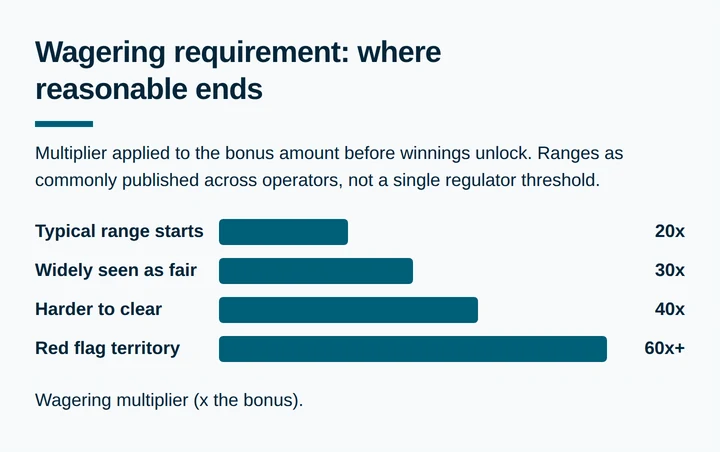
Deposit-match bonuses commonly carry wagering requirements in the roughly 20x-40x range. A requirement around 30x or lower on the bonus amount is generally considered reasonable. At 40x and above, especially when combined with restricted game contributions like table games counting only a fraction toward the requirement, clearing the bonus becomes significantly harder. This is a legitimate warning sign.
The wagering requirement should be stated clearly on the promotions page. The terms should also specify which games count fully toward the requirement, any maximum bet limit while the bonus is active, and whether the bonus is tied to a specific deposit method. If the terms are buried in a PDF or require clicking through three pages of fine print, that’s a choice. Legitimate operators know players want to understand bonus conditions, and they make them readable. When I see a bonus that’s mathematically impossible to clear, like a 60x requirement on a 200% match, I assume the operator is banking on players giving up. I’ve also caught myself reading a bonus promotions page and stopping cold at a clause listing restricted game contributions or a 40x-plus wagering requirement, which tells me everything I need to know about how the house views its players.
The Security Red Flag: SSL, Payments, and KYC
Security basics are easy to verify and tell you a lot about how a casino operates. I check three things before I ever create an account, and they work together as a quick legitimacy screen.
| Security Feature | Legitimate Casino | Scam Casino |
| SSL/HTTPS encryption | Valid certificate, padlock visible, no browser warnings | Missing or expired certificate, mixed content warnings |
| Payment processors | Recognisable, regulated processors (credit cards, established e-wallets, bank transfers) | Crypto-only or unrecognised processors, no chargeback path |
| KYC/age verification | Requests ID and age verification before real-money play or first withdrawal | Never asks for ID, or suddenly demands documents only after a withdrawal request |
Licensed platforms in Saskatchewan are required to verify age and identity before real-money play.
The legal gambling age here is 19.
A site that never asks for ID before letting you play is skipping a legal requirement. A site that only demands documents when you try to withdraw is misusing KYC to stall the payout. Licensed Saskatchewan platforms also offer self-exclusion and deposit-limit tools, consistent with the GameSense framework, so their responsible-gambling features are another marker of a legitimate operation. Our responsible gambling resources page covers those tools and the provincial helpline in more detail.
SSL is the weakest signal of the three. Even scam sites usually manage to get a certificate, but its absence is damning. Payment processor legitimacy matters more. If the only deposit options are cryptocurrency or prepaid cards with no recourse, you have no way to dispute a charge.
The Withdrawal Red Flag: Delays and New Demands
Delayed or refused withdrawals are where scams become obvious and where players lose the most money. The sharpest tell is new documentation demands appearing only after a win.
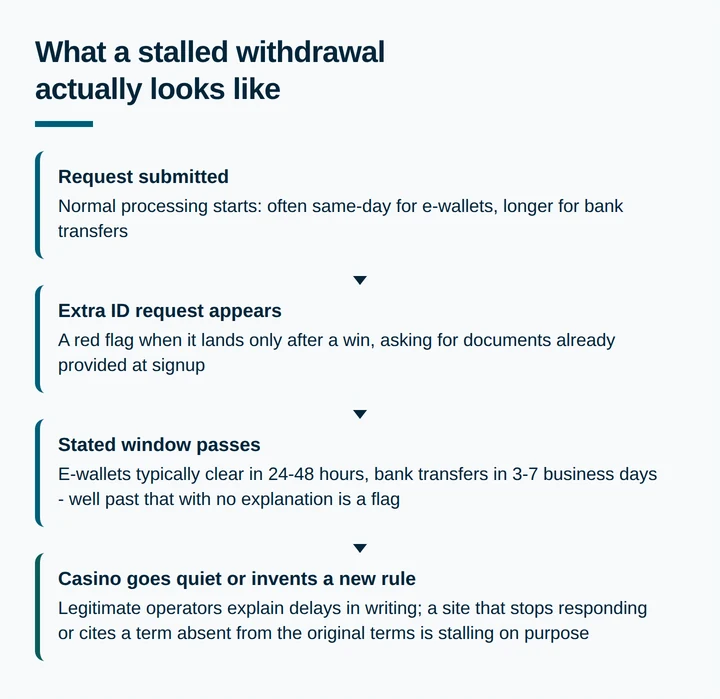
I’ve watched this play out repeatedly. I request a withdrawal after a win, and the casino comes back asking for “additional verification,” such as a selfie with ID, a utility bill, or proof of the deposit method. Some of this is normal. Licensed casinos do verify identity before payout, and that’s a sign of legitimacy. The red flag is when the demands keep escalating with no end point, or when the casino stops responding entirely. When a casino keeps moving the goalposts, first one document, then another, then a “review period” that stretches for weeks, the pattern is unmistakable. It’s a stall tactic designed to wear you down until you give up and walk away from your winnings.
Processing windows vary by method. E-wallet withdrawals at licensed casinos are typically approved within roughly 24-48 hours once KYC is complete, sometimes faster. Bank transfers take longer, commonly in the 3-7 business day range. These are industry-typical figures that vary by operator and by how quickly identity verification is completed.
A withdrawal pending beyond the stated window with no explanation is a warning sign. So are requests for documents that were never mentioned during signup, “technical issues” that appear only when you request a payout, and offers to “cancel” your withdrawal and keep playing instead.
A legitimate casino might be slow.
It will communicate. Silence after a withdrawal request is the loudest warning there is.
The Reputation Red Flag: Complaint Patterns, Not Single Reviews
Checking player reviews is smart.
You need to check the right way. No single authoritative, Canada-wide, non-affiliate complaint registry for online casinos exists. Sites like AskGamblers and Casino Guru are real and used by players. They’re commercial, affiliate-adjacent businesses, separate from any regulator. Treating any one of them as ground truth is a mistake.
Instead, look for a pattern across multiple independent sources. One angry review could be a player who didn’t read the terms. Ten complaints about the same issue, whether unpaid withdrawals, rigged games, or unresponsive support, form a signal. Multiple casino review sites can show whether complaints repeat across them, and gambling forums are another source where players discuss actual experiences, while the regulator’s own channels also matter where they exist.
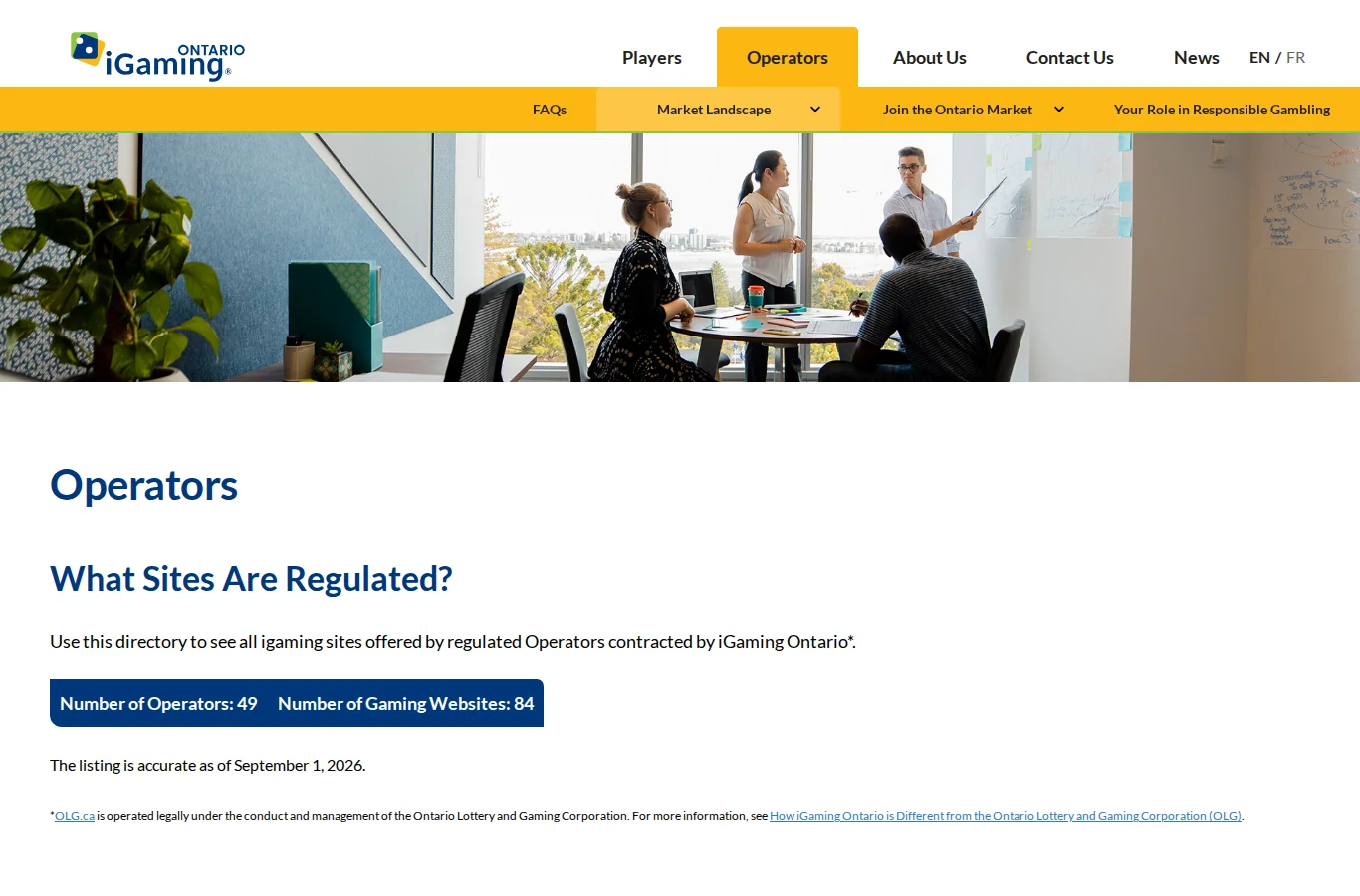
In Ontario, for example, iGaming Ontario runs a player-support and dispute-escalation page for operators registered in that province. This is a channel operated directly by the regulator itself. If you’re dealing with an Ontario-registered operator, that’s where you escalate.
The pattern matters more than any single source. If one site calls a casino “trusted” and three others document unpaid withdrawals, the weight of evidence points where the complaints are.
Frequently Asked Questions
How do I verify a casino’s license myself?
Go to the regulator’s own published register. For Saskatchewan, that means checking with SLGA/LGS or confirming the operator is PlayNow Saskatchewan. For other jurisdictions, find the licensing authority’s website and search their licensee list. A legitimate operator’s license number will appear in the register. If you can’t find it, the license claim is false.
What should I do if I’ve already deposited at a scam site?
Stop depositing immediately. Try to withdraw whatever balance remains, and document every interaction. Keep emails, chat logs, and transaction records. If the casino is registered with a regulator like iGaming Ontario, escalate through their player-support channel. For Saskatchewan players, the Problem Gambling Helpline at 1-800-306-6789 is available if you need support. You may not recover your money, but the documentation helps if you report the site to authorities.
Are all unlicensed casinos scams?
Most unlicensed casinos are simply operating outside any regulator’s reach. MGA or Curaçao licenses are real license types, and holding one still doesn’t authorise an operator to serve Saskatchewan residents under SLGA. Either way the practical risk lands in the same place. There’s no regulator, no dispute process, and no obligation to treat the player fairly. Even if it’s not an intentional scam, you have no recourse when something goes wrong.
What’s the fastest way to spot a fake license?
Check the license number against the regulator’s register. That’s definitive. A faster gut-check is to click the license logo in the footer. Legitimate operators link to their regulator’s entry. Fake sites often use an image with no link, or link to a page that doesn’t exist. Also check whether the license number format matches what the regulator actually uses. A quick search of the regulator’s name plus “licensee list” gets you to the register in under a minute.
Does a fast-loading, polished site mean a casino is legitimate?
No. Website quality tells you almost nothing about legitimacy. Scam operations often invest heavily in professional design because a polished site builds trust on sight. Some legitimate casinos have dated interfaces that work just fine. I’ve seen beautifully designed scam sites and clunky-but-honest operators. Judge a casino by its license, its terms, and its withdrawal behavior. Website polish doesn’t matter.