
Best Crypto Casinos in Canada: Bitcoin, Ethereum and More
GS Plain-English decode
Crypto casinos settle Bitcoin, Ethereum and Litecoin deposits and withdrawals in minutes. Traditional fiat transfers take days by comparison. In Canada, that speed is legal for recreational use. You’ll need…
Crypto casinos settle Bitcoin, Ethereum and Litecoin deposits and withdrawals in minutes. Traditional fiat transfers take days by comparison. In Canada, that speed is legal for recreational use. You’ll need to decide which coin to hold, which platform to trust, and what changes once tax rules or provincial licensing get involved. Tax concerns often confuse recreational players, but casual gambling winnings don’t require the filings many think they do.
Understanding Cryptocurrency Casinos
A cryptocurrency casino accepts digital coins for deposits and pays out winnings the same way. Two models exist. Crypto-friendly sites take Bitcoin and similar coins alongside credit cards and bank transfers, so players pick whichever payment method suits them. Pure-crypto platforms skip the traditional banking rails entirely and only handle digital coins, coming in and going out.
A crypto-friendly casino still routes its non-crypto payments through the same banks and card processors as any traditional site, carrying whatever delays and paperwork those rails involve. A pure-crypto platform has none of that infrastructure to work around, which shapes how the site is built and where it can legally operate.
Neither model is automatically the safer choice. What determines that is whether the specific casino, crypto-friendly or pure-crypto, is transparent about its licensing and how it handles player funds.
Popular Cryptocurrencies for Online Gambling
Four coins dominate crypto casino transactions, and each one has a different tradeoff between speed and acceptance. Bitcoin achieves the widest casino support. Ethereum offers quicker confirmations. Litecoin splits the difference. Tether gives you stability if you’d rather not gamble with a volatile asset.
| Cryptocurrency | Confirmation Time | Main Advantage |
| Bitcoin (BTC) | ~10 min first confirmation; 30–60 min for full finality on larger deposits | Widest acceptance across casinos |
| Ethereum (ETH) | ~12 sec per block; a few confirmations land in under a minute | Fast and widely supported |
| Litecoin (LTC) | ~2.5 min per confirmation; six confirmations around 15 min | Low fees, solid middle ground |
| Tether (USDT) | Depends on network used (often Ethereum or Tron) | Stable value, no volatility swings |
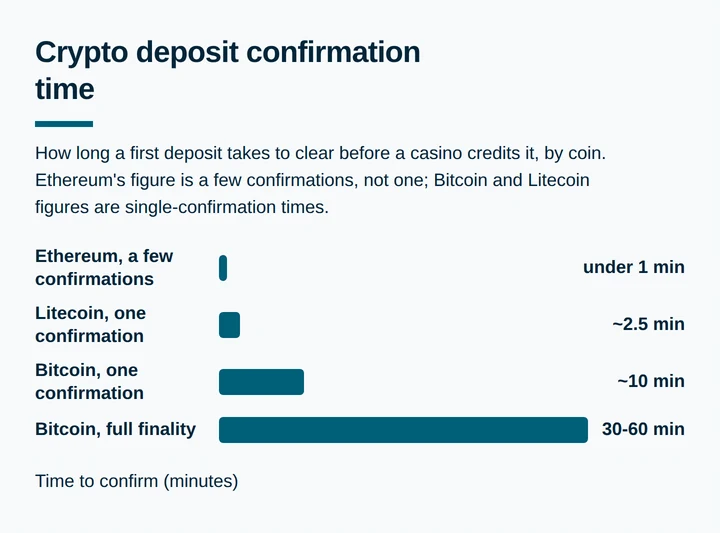
Bitcoin’s first confirmation typically lands in about ten minutes, though casinos that wait for three to six confirmations on larger amounts see full finality in roughly thirty to sixty minutes. Ethereum produces a new block every twelve seconds or so after Proof-of-Stake, which means most deposits clear in well under a minute. Litecoin’s average block time sits around two and a half minutes, so a single confirmation is quick but a fully settled transaction takes a bit longer.
If you want the fastest deposit, Ethereum is your coin. If you want the broadest choice of casinos, Bitcoin still wins. Tether is the pick for players who want crypto convenience without watching their bankroll swing with the market.
Advantages of Crypto Gambling
A Bitcoin deposit with one confirmation lands in roughly ten minutes, and Ethereum deposits typically arrive in under a minute. Card and bank withdrawals at traditional online casinos run through extra verification and banking steps that stretch the wait well beyond that, and the difference is easy to feel once you’ve used both methods.
Crypto transactions don’t require you to expose your banking details to the casino operator. You send coins from your wallet to the casino’s deposit address, and that’s the extent of the financial relationship. For players who value discretion, that’s a meaningful difference.
Network fees on Litecoin and Ethereum are typically smaller than the processing fees attached to credit card deposits. Over time, those savings add up, especially for players who move money frequently.
Disadvantages and Risks
The most obvious risk is volatility. Bitcoin can swing several percent in a single day, which means the value of your deposit can shift before you even place a bet. Tether solves that problem. Adoption is spotty, though. Not all casinos offer it.
Regulatory uncertainty is another factor. Crypto gambling operates in a grey zone in many jurisdictions, and the rules can change quickly. A platform that’s accessible today might restrict your region tomorrow.
Wallet security is on you. If you keep coins on the casino site and the operator gets hacked, your funds are gone. If you hold them in your own wallet and lose your private keys, they’re gone too. There’s no bank to call for a chargeback.
Crypto transactions are irreversible. A mistaken deposit address or a fraudulent platform means your money is gone permanently. The technology that makes payouts fast is the same technology that makes mistakes permanent.
How to Start Gambling with Cryptocurrency
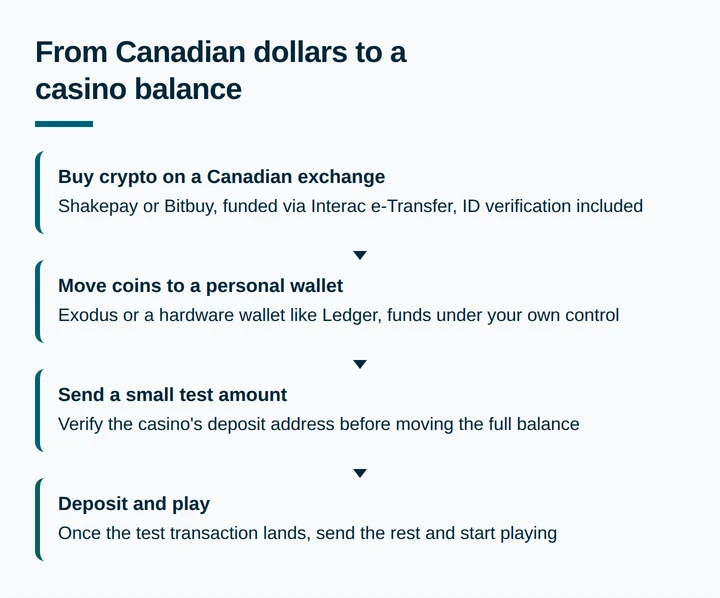
1. Buy crypto on a Canadian exchange. Shakepay and Bitbuy both let residents purchase Bitcoin and other coins using Interac e-Transfer. Identity verification is part of onboarding, which takes a few minutes.
2. Move coins to a personal wallet. Exodus and Ledger are popular choices. A personal wallet keeps your funds under your control rather than leaving them on the exchange.
3. Send a small test amount to the casino’s deposit address. Verify the address character by character before confirming. Sending a tiny test transaction first is worth the extra minute. It confirms the address works before you move your full balance.
4. Deposit and play. Once the test transaction lands, send the rest and start playing.
Crypto addresses are long strings of characters, and a single typo sends funds into the void with no recovery option. Players who skip this step to save two minutes sometimes learn that lesson the expensive way.
Selecting Reputable Crypto Casinos
Choosing a platform means looking at what you can independently verify. A reputable crypto casino should be transparent about its licensing, its software providers, and its house rules. If any of those details are hard to find, treat that as a warning sign.
Provably fair systems exist because game outcomes on a casino’s own server are otherwise a black box; the mechanism gives you a way to check the math yourself after the fact, independent of the operator’s word.
Software providers matter for a similar reason. A studio like Pragmatic Play or Evolution Gaming has regulatory audits and a public reputation riding on every game it releases, so a casino carrying recognizable names has already cleared a layer of scrutiny that an anonymous or unknown supplier hasn’t.
- Licensing: Which authority regulates the casino, and is that licence current?
- Provably fair games: Can you independently verify results?
- Withdrawal policy: What are the limits, and how long do payouts take?
- Bonus terms: Wagering requirements vary widely by operator, so read them carefully before opting in.
- Customer support: Test the response time before you need it.
Wagering terms deserve a closer look than most players give them. There’s no standard multiplier across the industry; the figure depends on the promotion, the casino, and the jurisdiction it operates in. Read the specific terms attached to whatever bonus you’re considering before opting in, rather than assuming it matches what a different casino offered last time.
Legal Considerations for Canadian Players
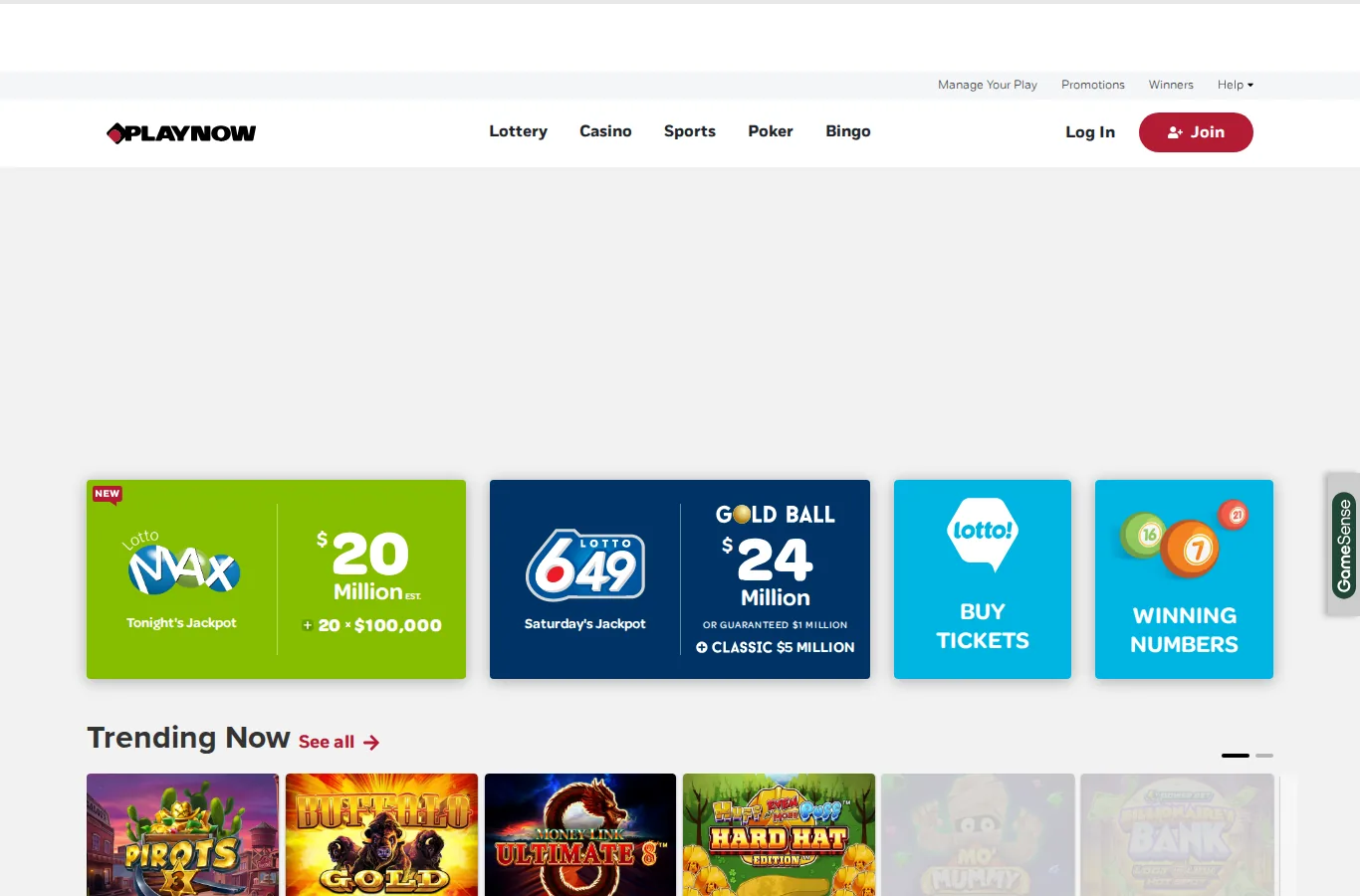
Canada’s gambling framework is provincial, which means the rules depend on where you live. In Saskatchewan, the Saskatchewan Liquor and Gaming Authority (SLGA) regulates gambling under The Alcohol and Gaming Regulation Act, 1997. The province’s only licensed online igaming platform is PlayNow.com, delivered by BCLC’s platform and operated by SaskGaming under a deal with the Saskatchewan Indian Gaming Authority (SIGA). It launched in Saskatchewan in November 2022.
Crypto gambling itself isn’t specifically addressed by the Criminal Code. Enforcement efforts focus on operators who run unlicensed sites; players placing bets face minimal legal scrutiny. That means the legal risk for a recreational player is minimal, though the platform you use still needs to operate within provincial rules.
Playing at an unlicensed offshore crypto casino remains a grey area that enforcement rarely pursues against players. Playing at a licensed provincial site like PlayNow.com is unambiguous. If you want zero legal ambiguity, stick with the licensed option. If you want crypto-specific gaming, understand that you’re operating in a space where the rules are still catching up to the technology.
Frequently Asked Questions
Is crypto gambling legal in Canada? Yes, for recreational players. The Criminal Code doesn’t specifically address crypto gambling. Enforcement focuses on the operators running unlicensed platforms, not on bettors placing wagers. Provincial regulators like Saskatchewan’s SLGA oversee licensed platforms, while unlicensed offshore sites operate in a grey zone that rarely creates legal exposure for players.
How long do crypto casino withdrawals take? It depends on the coin and the casino’s confirmation policy. Bitcoin withdrawals typically land within 30 to 60 minutes once the casino processes them, since full finality takes a few confirmations. Ethereum withdrawals usually arrive in under a minute. Litecoin sits in between at roughly 2.5 minutes per confirmation. The casino’s own processing time adds to the network time.
Are crypto casinos as safe as traditional online casinos? They can be, but the risk profile differs. Reputable crypto casinos use the same provably fair technology and licensed software providers as traditional sites. The added risk comes from wallet security and irreversible transactions. You’re responsible for your private keys, and there’s no chargeback mechanism if something goes wrong.
Do I need to report crypto gambling winnings for taxes? No, not for casual play. The CRA treats recreational gambling winnings, including crypto-casino winnings, as tax-free windfall gains. You don’t report them as income. That changes only if gambling becomes a commercial business for you. Regular, organized, sustained play backed by specialized knowledge gets taxed as business income instead. And if you invest your winnings and earn interest, dividends, or capital gains, that investment income is separately taxable.